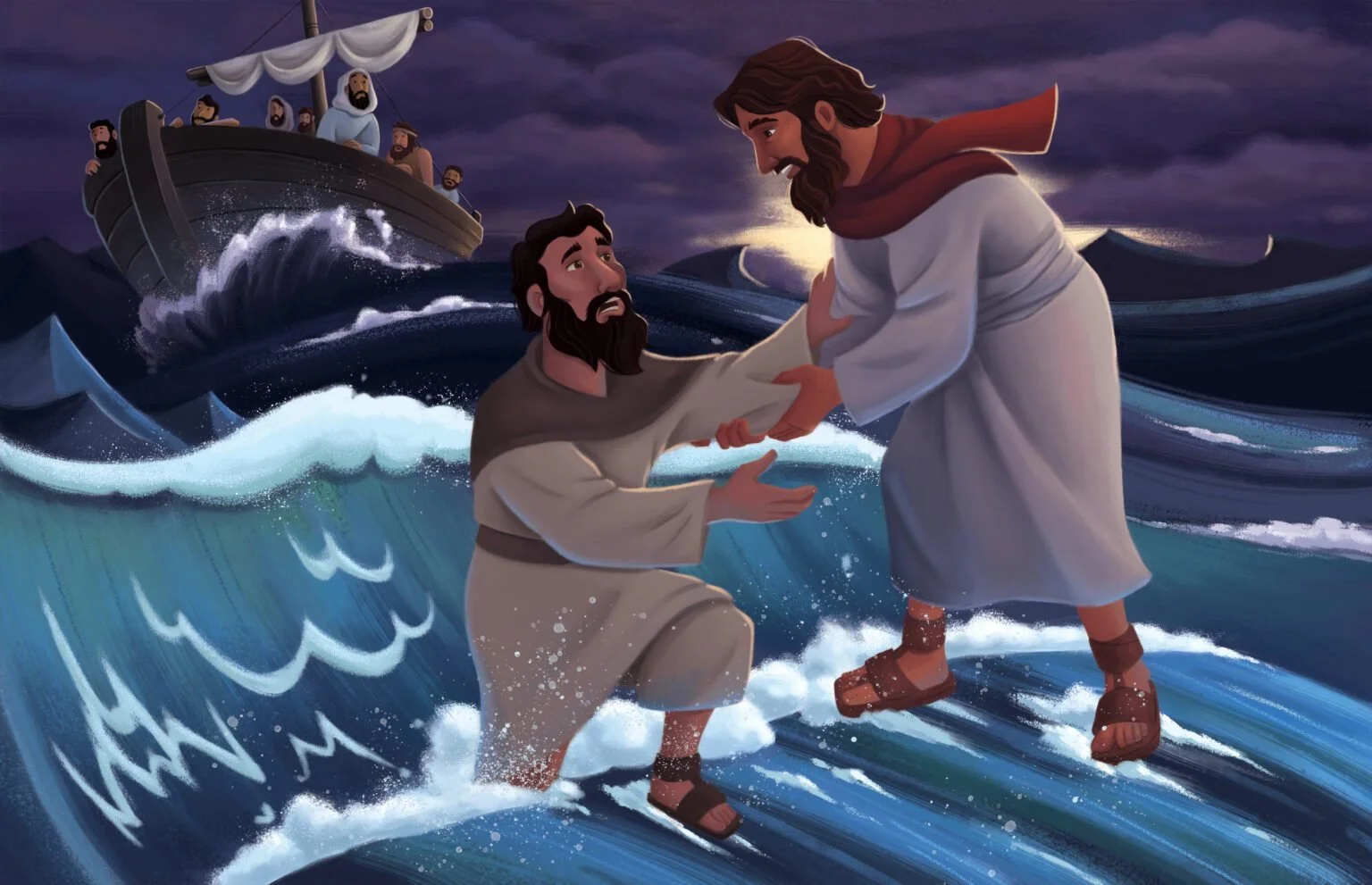
It was a dark and stormy night, a small boat battered by gusts of wind and rain, quickly drifting deeper into the abyss. It was a few hours before sunrise, but no one on the skiff slept. Instead, the fishermen’s worst nightmare materialized on the tenebrous waves—a ghost!
Something like that must have been going through the mind of one little girl in my Kidztown classroom as she stared at a cartoonish poster on the wall. Mouth agape, she was looking at an illustration of Jesus walking on the water, and her jaw was nearly on the floor. The girl was clearly in a trance of disbelief and amazement, having never heard the story from Matthew 14, Mark 6 and John 6.
To begin the class that morning, I intended to grab the children’s interest with an ice breaker. “Go to that side of the room if you’re more scared of snakes and this side if you’re more scared of spiders.”
The little girl, unafraid of either and uninterested in the game, asked, “Are we going to talk about the poster on the wall?”
“In just a bit. What about heights or tight spaces?” Again, neither.
“Why is that man standing on the water?”
“I’ll get to the Bible story in a little bit. Can you first choose a side?”
Begrudgingly, and with her eyes still fixated on the poster, she played along until we sat down and opened our Bibles. We read the brief account of the amazing events on the Sea of Galilee. All the kids enjoyed the story (who wouldn’t?), and we discussed the details and implications of our Lord being simultaneously terrifying and approachable. I could tell the little girl was simultaneously skeptical and intrigued.
Meanwhile, another little girl, seemingly seminary-trained, posed the question, “Did you notice how the waves calmed when Jesus got into the boat, whereas in Jonah, the waves calmed when Jonah left the boat?” That’s when my jaw hit the floor.
A few seconds later, the adults arrived to pick up their kids while I remained in the classroom lost in meditations about parallels between Jonah and Peter (“Simon Bar-Jonah”), the boat and the abyss, the belly of the fish and the arms of Jesus.
The thing about small children is that their imaginations are like the raging sea. Their brains are like the abyss, mostly empty, yet eager to swallow stories and new information. What I love about teaching them is that I get to experience, at least vicariously, their enthusiasm and joy when they encounter the old stories for the first time. I also get reminded how a childlike faith can unlock deep, complex gospel truth in a way that I, as an adult, struggle with.
Jesus loves the little children, and although this month has been dark and stormy, a living nightmare for many children in our town, we know that the raging sea has no power over him. He reaches out to rescue all of us who cry out from the sea, saying “I am. Do not be afraid.”