The Robot Wars Have Begun
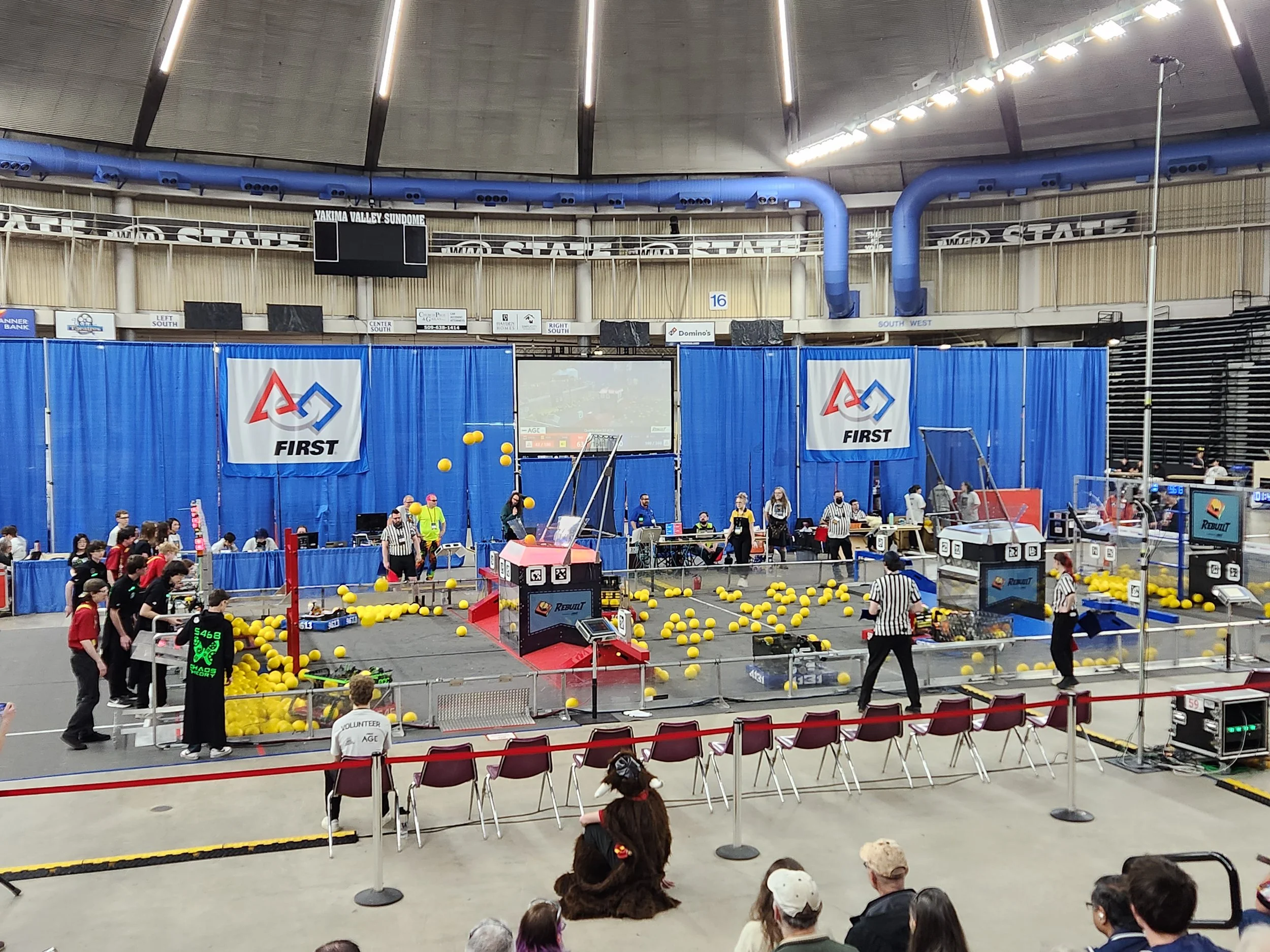
The beginning of each year, for the Evans household, is Robotics season. This year, our high school senior has devoted countless hours since early January designing and building a robot ex nihilo. He works alongside a team of about 20 industrious teenagers, travelling to various arenas, hoping their robot outscores dozens of others in exciting weekend-long competitions. They do their best to program the robot for good and not evil.
You have never been around such impressive young people. The organization, called FIRSTRobotics, prioritizes “gracious professionalism” and encourages innovation, teamwork, and fun. You will never see a fight and nary a frown at the events. What you will experience are silly costumes, fun cheers, spirited dances to “YMCA”, and robots that might be smarter than everyone in the venue. It’s basically the complete opposite of what I experienced playing baseball in my youth.
A man with pink hair, rainbow pants, and a dry wit emcees this weekend’s competition. He introduces each team, mimics their signature dance, and leads the crowd of about 500 in a “3-2-1!” countdown. Mayhem ensues next in a three-on-three battle where each robot speeds around the pickleball court-size playing field, gathering and hurling as many honeydew-size balls as possible into a 6-foot-high hub. The students watch idly during the first 30 seconds because their robot is pre-programmed to do all this work autonomously. The most advanced robots finish the autonomous period airborne, clinging to a ladder rung.
Students then grab their game controllers, and for the next two minutes, furiously drive their creations around the field. Referees wave flags at foul play, volunteers gather balls launched beyond the playing field walls, and fans cry their delight over the announcer’s play-by-play and a never-ending playlist of classic pop/rock.
My son’s team’s robot spends the final ten seconds of the match showing off by climbing the ladder and flipping completely upside down. No other robot can perform this trick, so the crowd goes wild. All eyes are now on the giant screen waiting for the final score. “Red Alliance Wins!” More cheering, but barely a second goes by before the students are preparing for their next match, scribbling notes and reassembling broken parts after an exhausting two-and-a-half-minute battle.
The combined brainpower in the arena could solve most of the world’s problems. This is about more than building robots that can hurl projectiles and climb ladders. Most of these students will go on to become successful engineers, introducing our world to new and exciting technologies beyond our wildest imaginations. Should we be afraid? Any student you ask, “Aren’t you worried the robots will turn on us,” will wryly say the same thing. “It’s certainly possible.”
Many people today are concerned about the advent of artificial intelligence, social media, and other technologies that seem to be hurling us away from simpler, more wholesome times. These technologies have the potential to obliterate traditions our forefathers built, like family values, hard work, and meaningful relationships.
It’s helpful to remember that every generation deals with this technophobia. Go back a few years, and we feared the Internet. Before that, television. Drones, rockets, airplanes, tanks, chariots, horses—these have all caused those who had never seen them before to tremble with fear. A few thousand years ago, a small cavalry would have caused large infantries’ knees to buckle and waive the flag of surrender.
The point is that there is no technology we need to fear. God always knows what’s around the corner, and until Jesus comes back, we can be certain bad actors will use technology for evil. But our God is “The Lord, strong and mighty, the Lord, mighty in battle.” (Ps 24:8)
The robots are mighty in battle, too, and we are commanded to wear eye protection when walking near them. “Safety first” reminders abound. But the students seem harmless, and many of them are God-fearing believers. It’s evident from the way they encourage one another. The spirit of “gracious professionalism” is obvious throughout the weekend, even in the hotel pool where the teenagers allow an annoying little brother to join their Marco Polo game. They say “thank you” and let others go in line ahead of them at breakfast.
Will the robots turn on us? Possibly. But at the end of the weekend, we celebrate the innovation, teamwork, and fun times. Like a cavalry after war, the students corral their robots and return home. They drive back to family values, hard work, and meaningful relationships, just like they did thousands of years ago, before robots roamed the earth [possibly] looking for humans to destroy.
“Some trust in horses, and some in chariots,” Psalm 20:7 says, “but we trust in the name of the Lord our God.”